 chapter
Chapterwise retirement guide
"Are You Done?" Isn't a Yes or No Question
A viral post asks if $1.5M at 55 is enough to retire. Here's the real math for Canadians, including the CPP/OAS bridge and safe withdrawal rates.

A post like this shows up on social media every few months, and it always gets shared the same way: a tidy scenario, a big number, and a blunt question at the end. You're 55. House paid off. Kids grown. $1.5 million invested. A job that pays well but that you've stopped being able to stand.
Are you done?
The honest answer is that nobody can tell you that from four bullet points, and any comment section that confidently says otherwise is skipping the actual math. But the question underneath the post is a good one, and it deserves a real answer instead of a scroll-past reaction. So let's actually work through it.
What $1.5 million really produces
The old rule of thumb, the "4% rule," said you could withdraw 4% of a portfolio in year one, adjust for inflation every year after, and reasonably expect it to last 30 years. On $1.5 million, that's $60,000 a year.
But that rule was built for a 30-year retirement starting around 65, and the person in this scenario is 55, not 65. That changes the math meaningfully. A retirement starting at 55 could easily need to stretch 35 to 45 years, and recent research has moved on from the original flat 4% figure. Some updated 2026 research puts a sustainable starting rate closer to 3.5% to 4% for a horizon this long, while more optimistic analysis allows for something closer to 4.5% to 5% if the retiree stays flexible on spending in down years. On the same $1.5 million, that range works out to roughly $52,500 to $75,000 a year, depending on which research and which assumptions you trust, and depending on how willing you are to adjust spending if markets have a rough stretch early on.
That's a meaningful gap, and it's the first thing worth being honest about: there isn't one clean number here. There's a range, and where you land in that range depends on how much flexibility you're willing to build into the plan.
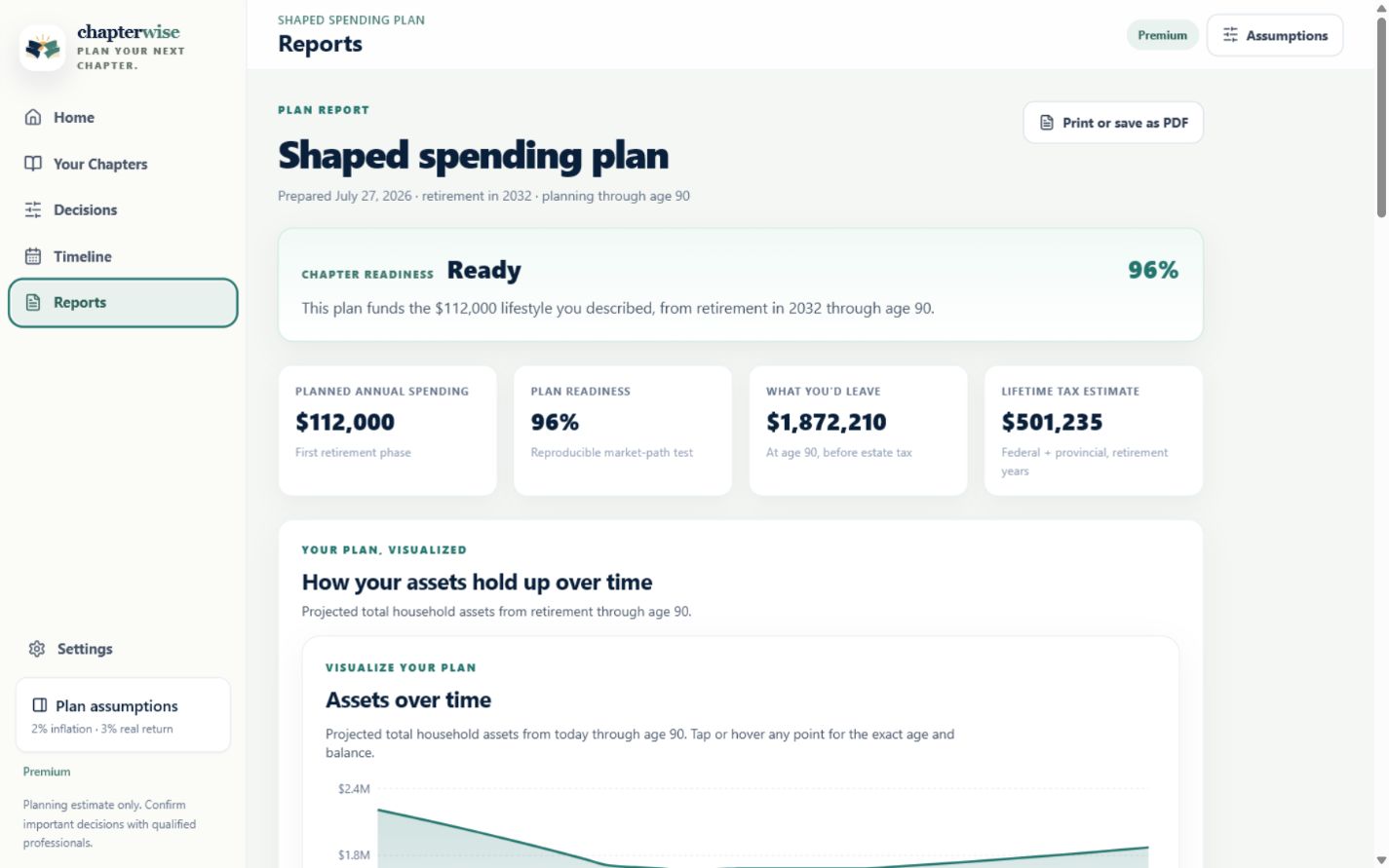
The Canadian version of this math looks different in one big way
Most of the commentary this kind of post generates online is written for an American audience, and it usually spends a lot of time worrying about one specific problem: health insurance. In the U.S., retiring at 55 means a full decade of self-funding healthcare before Medicare eligibility at 65, a genuinely large and unpredictable cost that early American retirees have to plan around carefully.
In Canada, that specific problem mostly doesn't exist. Provincial healthcare coverage doesn't depend on employment or age the way U.S. coverage does, so a 55-year-old Canadian retiree isn't staring down a decade of self-funded medical premiums the way their American counterpart is. That's a genuine structural advantage worth naming clearly, since a lot of the anxiety baked into this kind of post simply doesn't translate north of the border.
What Canadians do need to plan around instead is a different kind of gap: the bridge between 55 and when CPP and OAS become available. CPP can start as early as 60, at a permanently reduced rate, or as late as 70. OAS can't start before 65. That means anyone retiring at 55 is self-funding the entire first five to ten years of retirement from savings alone, with no government benefit income landing until CPP kicks in at the earliest, and none of the larger, more secure income until OAS and a later-start CPP arrive years after that.
This changes how the withdrawals should be shaped, not just how much gets withdrawn. Money often needs to come out faster in the bridge years, before benefits start, and can ease off once CPP and OAS begin covering part of the picture. A flat withdrawal rate applied evenly across the whole retirement usually isn't the right shape for this situation. A bridge strategy, higher withdrawals now, tapering as benefits phase in, usually fits better.
Is $150,000 actually the number that matters
Here's a detail the original post glosses over, and it's a big one: the $150,000 salary isn't the number this plan actually needs to replace.
A working salary gets taxed, has retirement contributions coming off the top, often covers a commute, work wardrobe, and the general cost of simply being employed. A retiree with a paid-off house typically needs to replace a meaningfully smaller number than their old salary, commonly cited around 70% to 80% of pre-retirement income for a comparable lifestyle, sometimes less for someone whose mortgage is already gone and whose kids are financially independent.
If actual retirement spending in this scenario is closer to $90,000 to $110,000 a year rather than a full $150,000, the entire math shifts. That range sits comfortably inside even the more conservative withdrawal estimates on $1.5 million, without needing to lean on the more optimistic end of the research at all. This is usually where the real answer to "are you done" hides: not in the headline salary number, but in an honest, itemized look at what life actually costs once the job, the mortgage, and the associated expenses are gone.
A smaller first step
Try the decision before you sign up
This directional preview reuses the same illustrative logic as the homepage. It is not a recommendation or a personalized projection.
The tax layer nobody puts in a social media post
How that $1.5 million is actually split across account types matters as much as the total. In Canada, a $1.5 million portfolio spread across an RRSP, a TFSA, and a non-registered account behaves very differently than the same total sitting entirely in one account type.
RRSP withdrawals are taxed as regular income, which means withdrawing too much too early can push you into a higher bracket than necessary. TFSA withdrawals are completely tax-free and don't affect other benefits. Non-registered accounts trigger capital gains tax on the growth portion when sold. A well-sequenced plan often draws down these accounts in a deliberate order, sometimes prioritizing lower-tax RRSP withdrawals in the bridge years specifically to use up lower tax brackets while other income is absent, rather than saving RRSP withdrawals for later when CPP, OAS, and eventually mandatory RRIF withdrawals are all landing in the same tax year and pushing income higher than necessary. This kind of sequencing can be worth tens of thousands of dollars in tax saved over a full retirement, and it's invisible in any post that only quotes a single total portfolio number.
The part that isn't financial at all
Even with the math fully worked out, there's a psychological pattern worth naming honestly, because it shows up constantly in exactly this scenario: "one more year syndrome." It's the well-documented pattern of having genuinely reached your number, on paper, and still not being able to pull the trigger, finding one more reason, one more bonus cycle, one more market dip to wait out, one more year to feel fully ready.
It's not irrational. Leaving a stable, well-paying job is a real decision with real weight, and some hesitation is healthy caution, not fear. But it's worth being honest about which one is actually driving the delay: a genuine gap in the plan that needs solving, or a comfort with the familiar that no spreadsheet is ever going to fully resolve. Those two problems need completely different solutions, and confusing them is how "one more year" quietly turns into five.
So, is this person done
Based on the numbers alone, probably close, and possibly yes, particularly once actual spending needs are separated from the old salary figure. But "probably close" isn't the same as "yes," and the difference between them is exactly the kind of detail a real plan resolves and a social media post never can: the actual account mix, the actual spending target, the bridge strategy to CPP and OAS, and an honest read on whether the hesitation is financial or simply human.
That's not a discouraging answer. It's the more useful one. The post asks a yes or no question. The real answer is a plan.
This article is for general educational purposes and reflects withdrawal rate research and Canadian tax and benefit rules believed accurate as of 2026. It isn't personalized financial or tax advice; your own numbers, account mix, and timeline should be run through a real plan rather than a general scenario.
Related chapters in this series
- When Does This Chapter Begin?
- Doing Everything Right Isn't the Same as Doing It in the Right Order
- The Worst Possible Day to Start, and It Still Worked Out
- The House Always Wins, Except When It Doesn't