 chapter
2026 CPP guide
Understanding CPP: what it means for your next chapter
CPP can be one of the steadiest parts of retirement income. The difficult part is not whether it matters, but how its timing fits your savings, taxes, health, longevity and household.
CPP is a taxable, inflation-indexed lifetime pension. You can start between 60 and 70. Starting earlier permanently reduces the monthly amount; delaying permanently increases it. The best date is a household cash-flow decision, not a rule of thumb.
What CPP actually is
The Canada Pension Plan is a contributory, earnings-related public pension. It is not a savings account with your name on it, and it is not a discretionary government bonus. Your contribution history, covered earnings and start age help determine a monthly taxable pension that can continue for life and is adjusted annually with the Consumer Price Index.
That makes CPP different from an RRSP or TFSA. Personal accounts can be inherited and invested, but their balances can run down. CPP pools longevity risk across contributors: its value becomes especially visible if retirement lasts into your 90s.
How contributions work in 2026
The CPP enhancement has been phasing in since 2019. Once fully mature for someone with 40 years of enhanced contributions, it is designed to replace one-third of covered average work earnings rather than one-quarter, and the upper earnings ceiling is about 14% above the first ceiling.
The first $3,500 of earnings remains exempt from the base and first additional contribution. An employee can contribute up to $4,230.45 on earnings through the first ceiling, plus up to $416 of CPP2 on earnings between $74,600 and $85,000. A self-employed person covers both halves.
A single future “maximum CPP” estimate can mislead because future ceilings and indexation will change. The safer statement is that a fully mature enhancement is designed to raise the maximum pension by more than 50% compared with the pre-enhancement design.
How much CPP pays today
For a new pension beginning at age 65 in January 2026, the maximum is $1,507.65 per month. The average for new age-65 beneficiaries reported for April 2026 is $877.01 per month. Most people do not receive the maximum because it requires a long history of contributions near the annual earnings ceilings.
Use your Statement of Contributions in My Service Canada Account for planning. A headline maximum is not a personal estimate.
The real decision: when to start
| Start age | Permanent adjustment from age 65 | What it can mean |
|---|---|---|
| 60–64 | Down 0.6% per month; 36% at age 60 | Income arrives sooner, but the lifetime monthly floor is smaller. |
| 65 | No age adjustment | The standard reference point. |
| 66–70 | Up 0.7% per month; 42% at age 70 | Savings may need to bridge the gap, followed by a larger lifetime pension. |
The simple age-65 versus age-70 crossover is about age 81–82 when you compare only the 42% age adjustment. Real household results can differ because taxes, investment returns, spending, RRSP/RRIF withdrawals, OAS, GIS, survivor rules and the timing of each partner all interact.
Some households deliberately withdraw more from an RRSP or RRIF before CPP begins. That can fund the waiting years, reduce future registered balances and smooth taxable income. It is a coordination strategy—not proof that everyone should delay.
Two Chapterwise scenarios
These fictional examples were run through the Chapterwise deterministic planning engine in today’s dollars. They isolate CPP timing while keeping OAS at 65. They are illustrations, not predictions or recommendations.
Scenario 1 · A long retirement runway
Maya and Colin can afford the bridge
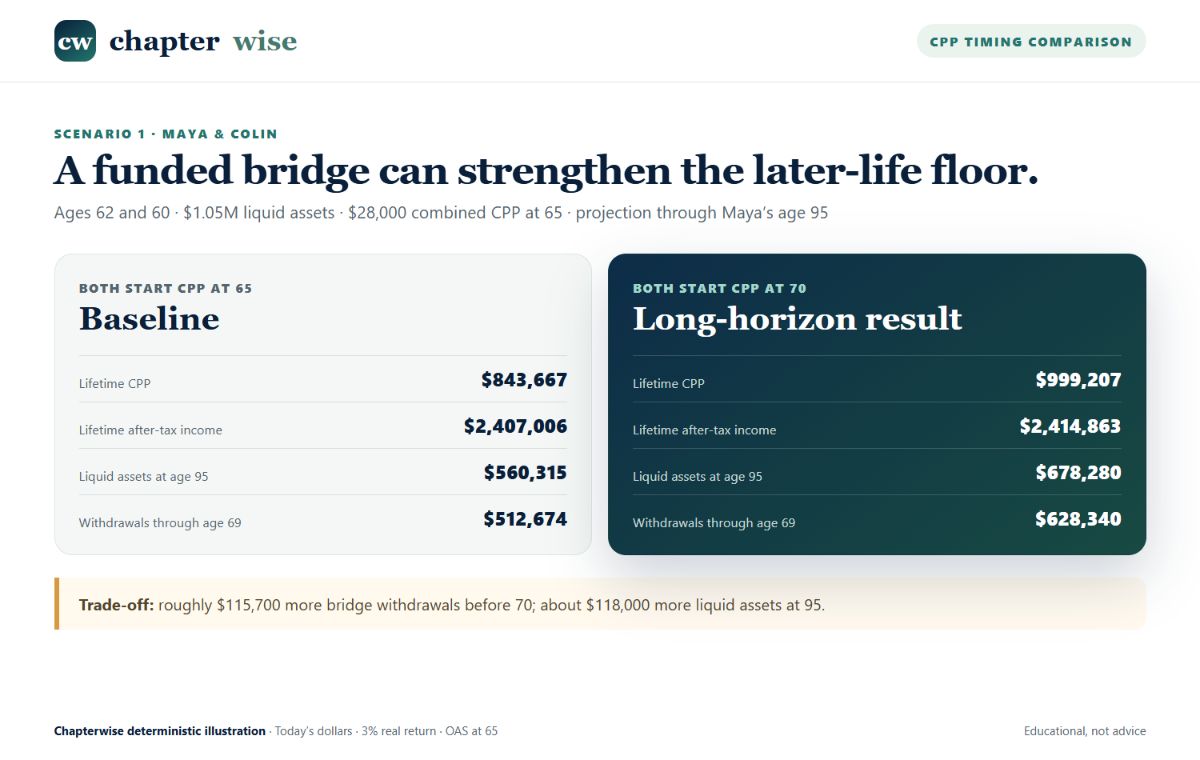
Maya is 62, Colin is 60, and they have $1.05 million of liquid retirement assets. Their estimated combined CPP at 65 is $28,000 a year. The plan uses phased pre-tax spending of $88,000, $76,000 and $68,000 and runs until Maya is 95.
- Waiting from 65 to 70 required about $115,700 more withdrawals through age 69.
- It produced about $155,500 more lifetime CPP in the model.
- Projected lifetime after-tax income rose about $7,900.
- Liquid assets at age 95 were about $118,000 higher.
The lesson is not “always delay.” It is that a funded bridge can buy a larger late-life income floor and may still protect assets over a long horizon.
Scenario 2 · A shorter planning window
Denise and Paul value income sooner
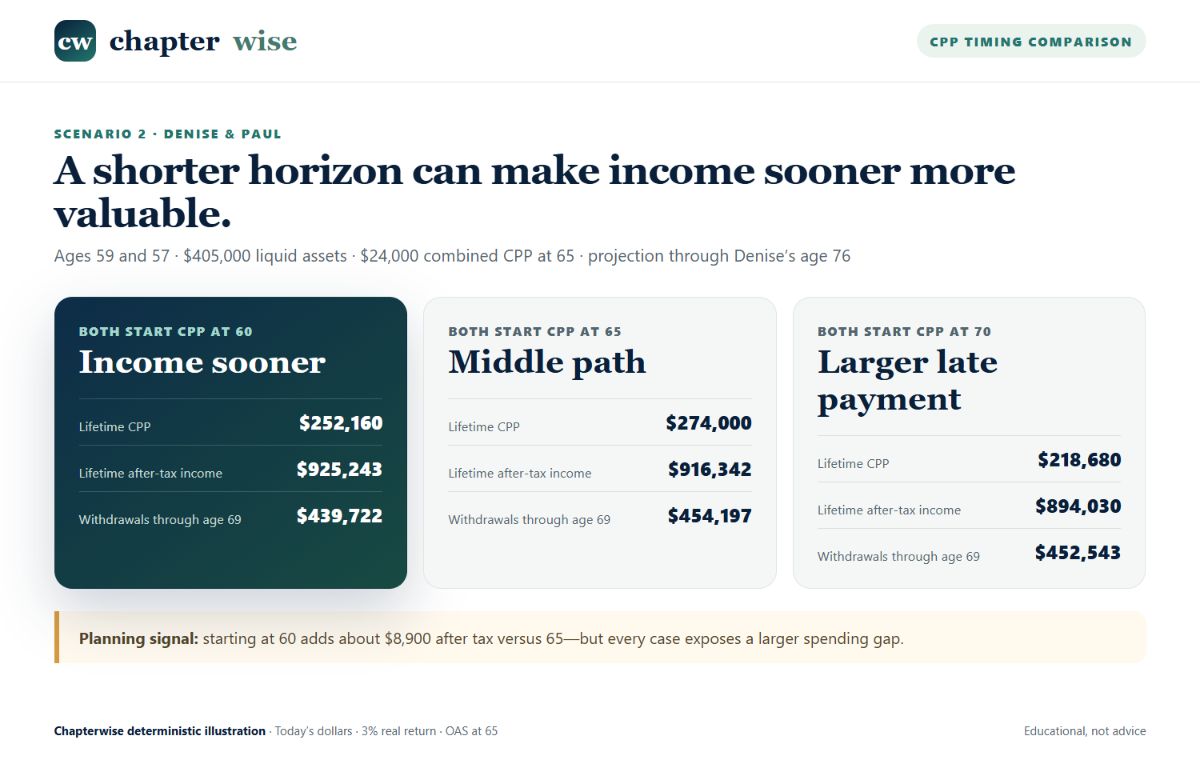
Denise is 59, Paul is 57, and they have $405,000 of liquid retirement assets. Their estimated combined CPP at 65 is $24,000 a year. This intentionally short scenario runs only until Denise is 76.
- Starting at 60 delivered about $8,900 more projected after-tax income than waiting to 65 over that horizon.
- It delivered about $31,200 more than waiting to 70.
- Starting at 60 reduced bridge withdrawals through age 69 by about $14,500 versus starting at 65.
- The portfolio was depleted in both the age-60 and age-65 cases, signalling that CPP timing did not solve the larger spending gap.
Here, early CPP helps near-term cash flow. The more important planning question is the spending and savings shortfall exposed by every timing choice.
Scenario assumptions: Alberta, 3% real investment return, 2% inflation, OAS starting at 65, benefits indexed in the projection, no individualized health or mortality forecast, and no guarantee of future returns. Rounded differences may not add precisely.
A smaller first step
Try the decision before you sign up
This directional preview reuses the same illustrative logic as the homepage. It is not a recommendation or a personalized projection.
What happens for a spouse or partner
A CPP retirement pension does not simply transfer to a survivor. If a survivor is 65 or older and is not receiving another CPP benefit, the survivor’s pension is generally 60% of the contributor’s calculated age-65 retirement pension. If the survivor is under 65, the formula uses a flat-rate portion plus 37.5%.
If the survivor already receives CPP retirement or disability benefits, Service Canada combines the benefits using a separate calculation. It is not a simple “stacking” formula, and the result is not necessarily the sum of both pensions. For 2026, the published maximum combined survivor’s and retirement pension at age 65 is $1,531.56 per month.
For someone without an eligible spouse or common-law partner, CPP contributions are not inherited like an account balance. The standard death benefit is a one-time $2,500 payment. An additional $2,500 may apply only when the contributor died before receiving a retirement or disability pension and did not leave an eligible survivor.
A tool worth knowing: pension sharing
CPP pension sharing can shift part of the retirement pension earned during the period a couple lived together. The couple must be living together, and at least one spouse or common-law partner must be receiving or have applied for CPP retirement pension. Sharing does not increase the household’s combined CPP, but it may reduce household tax.
This is different from pension income splitting on a tax return. CPP and QPP benefits are not eligible for that separate CRA election.
Three things to double-check
- Do not assume you will receive the maximum. Check your Statement of Contributions and estimate in My Service Canada Account.
- Request the child-rearing provisions if they apply. Periods of low or no earnings while you were the primary caregiver of a child under seven may improve CPP benefits, but you must provide the required information.
- Do not wait beyond 70. CPP does not increase after 70. If you apply after 65, a requested retroactive start date can generally go back no more than 11 months before the application month and not earlier than the month after your 65th birthday.
The bottom line
CPP works best when it is coordinated with the rest of the plan. A larger pension at 70 can be valuable longevity insurance; income at 60 can protect near-term cash flow. The right question is: what funds the years before CPP, what happens after it begins, and how does the choice hold up if life lasts longer—or shorter—than expected?
Official sources
Chapterwise provides educational planning estimates, not financial, tax or investment advice. Assumptions and government rules can change; verify important decisions with official sources and qualified professionals.