 chapter
Chapterwise retirement guide
Starting the Count Later Than Planned
Feeling behind on retirement savings in your 40s or 50s? Here's how RRSP catch-up room, delayed CPP, and working longer can close the gap.

Of everyone currently saving for retirement, one generation consistently reports feeling the least ready. Not the youngest workers, who have the most time but also the least saved. Not the near-retirees, who at least know roughly what they're working with. It's the generation in the middle, the one that spent its 30s and 40s absorbing a financial crisis, a shift away from employer pensions, rising costs, and often a family to support at the same time, that now reports the lowest confidence heading into retirement of any age group.
If that's you, and the years ahead feel shorter than the plan needs them to be, this chapter is worth reading without the shame that usually comes attached to it.
Why "starting late" isn't the whole story
The instinct, once you notice you're behind where you'd hoped to be, is to treat the gap as something that needs to be dramatically, urgently closed, often through decisions that feel more like panic than planning. That instinct is understandable and usually unhelpful. The years already spent aren't recoverable, but they also aren't the whole story. What matters most from here is what the remaining years are actually used for.
A person starting serious saving at 45 or 50 isn't in the same position as someone starting at 25, but they're also not without real tools. Income tends to be higher in these years than it was earlier. The kids, if there are kids, are often closer to their own launch than they used to be. And several parts of the Canadian retirement system are specifically built to help later savers catch up.
The tools built for exactly this chapter
- Catch-up contribution room. Unlike some retirement systems, Canadian RRSP contribution room doesn't expire. Room you didn't use in your 30s is still available now, meaning a higher-income year in your late 40s or 50s can absorb a much larger contribution, and a much larger deduction, than the same dollar amount would have delivered earlier.
- A realistic look at retirement age. The average retirement age has been climbing for years, and working a few years longer than originally planned, even part time, changes the math considerably. It shortens the number of years savings need to cover and gives contributions more time to grow.
- CPP and OAS timing as a lever, not an afterthought. For someone who feels behind on personal savings, delaying CPP, even by a few years, can meaningfully increase guaranteed lifetime income later, effectively doing some of the catching up that feels hard to do through savings alone.
- An honest, current picture, not an old assumption. A lot of "feeling behind" is based on a vague sense of falling short rather than an actual current number. Running the real math, what's saved, what's coming in from CPP and OAS, what retirement might realistically cost, often reveals a gap that's smaller and more workable than the anxiety suggested.
A smaller first step
Try the decision before you sign up
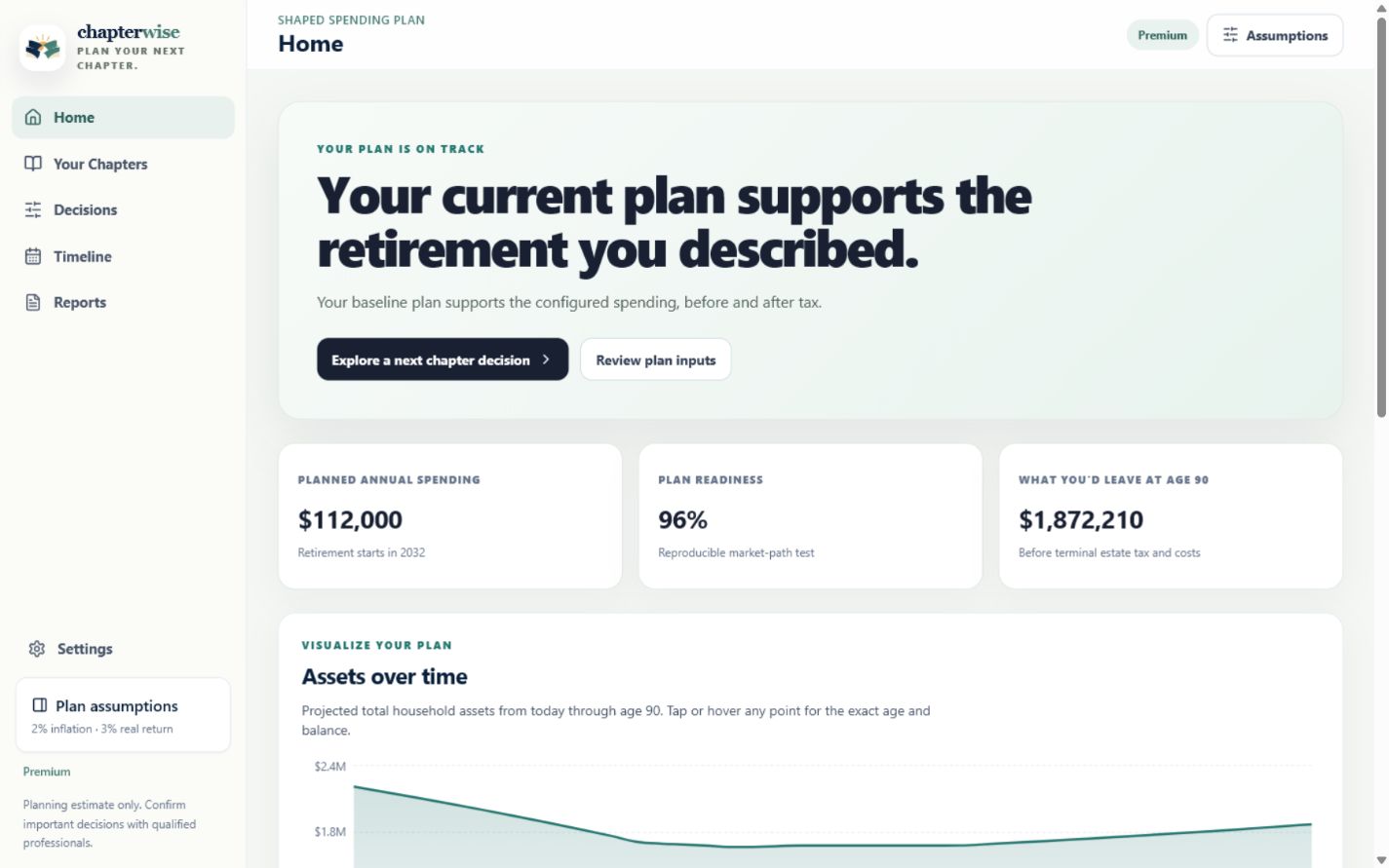
This directional preview reuses the same illustrative logic as the homepage. It is not a recommendation or a personalized projection.
What doesn't help
It's worth naming a few instincts that tend to make this chapter harder, not easier. Chasing higher returns through riskier investments to "make up for lost time" usually adds risk without reliably adding the growth it's chasing. Comparing your timeline to a generic industry benchmark built around an earlier, uninterrupted savings history usually just adds discouragement without adding useful information. And treating the whole situation as a crisis, rather than a chapter that simply started later than planned, tends to produce paralysis instead of the steady action that actually closes gaps over time.
A chapter that started late, not one that's lost
Starting your serious saving years later than you'd hoped isn't the same as starting too late. It's a different shape of story, one that leans more on the tools built for exactly this situation, catch-up contribution room, working a bit longer, smarter benefit timing, than on trying to recreate three decades of compounding in one. The years ahead are still the years that matter most for how this chapter ends.
This article is for general educational purposes and describes common patterns in retirement savings timelines. It isn't personalized financial advice; your own catch-up strategy depends on your individual circumstances and is worth working through with a clear, current picture of your own numbers.